I recently came across an Instagram post claiming that homeschooling was “easy.”
As someone whose only personal homeschooling experience came during the Covid years with my own children, I immediately laughed out loud. Those years taught me many things, but “easy” was definitely not one of them.
As I read through the comments, I found myself thinking about the message that word sends to parents. Whether you’re teaching in a classroom or teaching at the kitchen table, educating children is important, meaningful, exhausting work. Calling homeschooling “easy” can create unrealistic expectations for parents who are already carrying an enormous responsibility.
While I can’t offer advice on the day-to-day details of homeschooling, I can offer insight into something I’ve seen repeatedly as a teacher: the transition from homeschooling to traditional school.
I teach in a high-performing public school where many homeschooled students enter during fourth and fifth grade. Over the years, that experience has given me a unique perspective on some of the challenges these students may face — academically, socially, and emotionally — as they begin a completely new chapter.
My hope is that this post encourages and prepares parents who are considering making that transition in the future.
Encouraging Independence Before the Transition to Traditional School
One challenge many parents notice during the transition from homeschool to public school is the level of independence required during the school day.
When I work with my own children at home or one-on-one in the classroom, I notice how much easier it is for them to stay focused when an adult is nearby — guiding, redirecting, encouraging, or simply sitting beside them while they work. Honestly, most children work better with that kind of support, especially when they are younger.
In a traditional classroom setting, however, teachers are balancing the needs of many students at once. Even in excellent classrooms with attentive teachers, it simply isn’t possible to provide constant one-on-one support throughout the day. Because of this, students entering traditional school after homeschooling often need time to adjust to working more independently.
That doesn’t mean children should suddenly be expected to do everything on their own. Independence is a skill that develops gradually and looks different for every child depending on age, personality, attention span, and developmental readiness. Some children naturally need more redirection, reassurance, or accountability than others.
One thing I’ve noticed is that some students (including many traditional school students) become very accustomed to receiving immediate reassurance before moving on. In a classroom, though, children sometimes need to try, struggle a little, and problem-solve before a teacher is available to help. While that can feel uncomfortable at first, those moments often help children develop confidence because they begin to see that they are capable of figuring things out independently.
If you anticipate transitioning your child from homeschool to traditional school in the future, one helpful step is to slowly begin increasing opportunities for independent work at home. This doesn’t have to happen all at once. Small changes can make a big difference over time.
You might gradually:
- increase the amount of time your child works without immediate assistance
- encourage them to reread directions before asking for help
- build stamina for completing assignments independently
- practice waiting a few minutes before receiving feedback or correction.
The goal is helping children build confidence in their ability to work through challenges independently before entering a traditional school environment.
Productive Struggle
As a parent or teacher, there is almost nothing more unnatural than allowing a child to struggle. Every instinct in me wants to step in, fix the problem, and make things easier.
Over time, though, I realized that constantly rescuing my children sometimes prevented them from learning and growing — not just academically, but emotionally as well.
This was especially true with my oldest child. I was often too quick to remove obstacles or solve problems for her. By the time my second child came along, I had learned the value of stepping back and allowing him to work through challenges more independently.
These two pictures perfectly capture the difference.
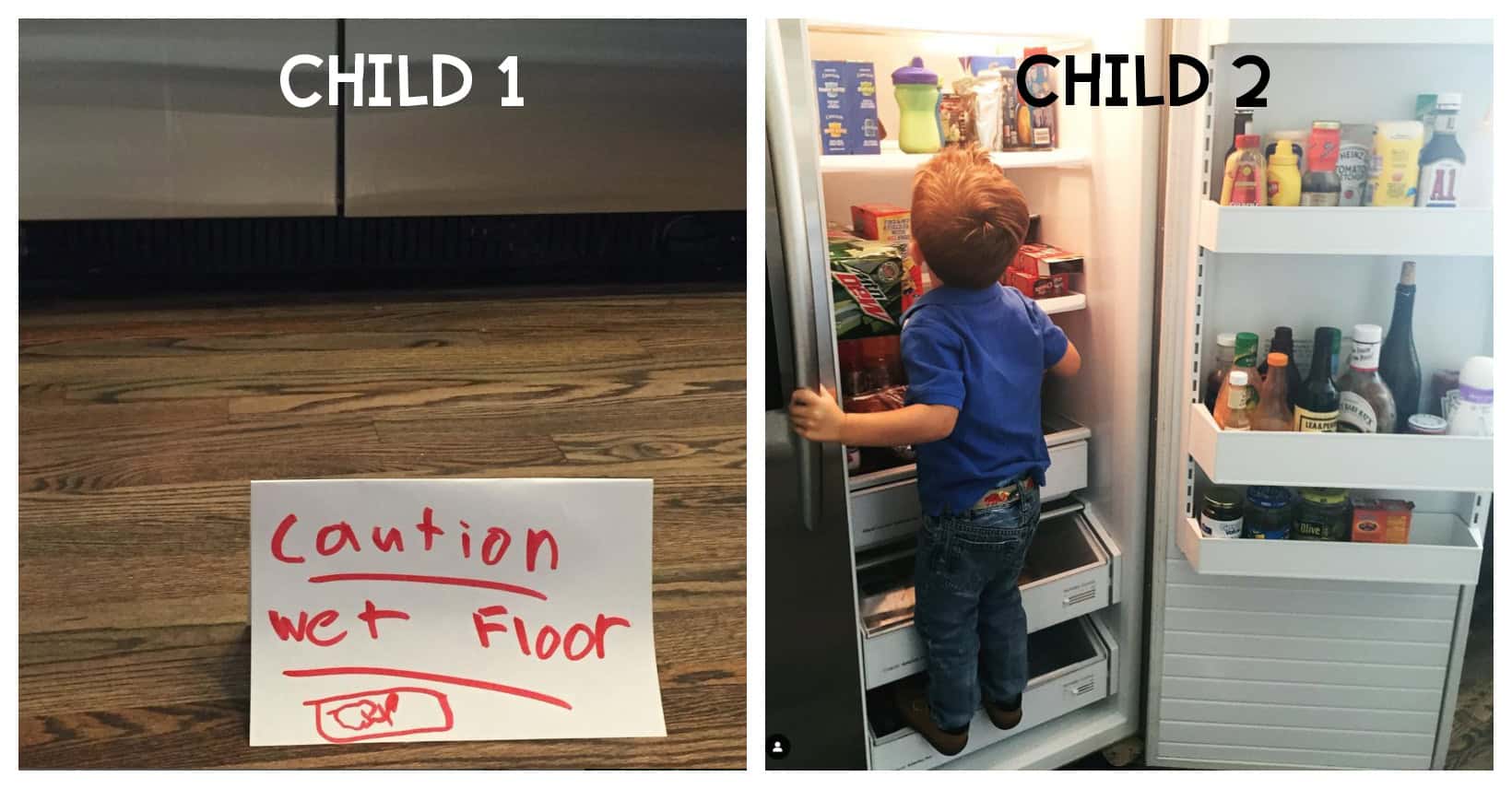
One child spills a drink and creates a “caution sign” while waiting for me to clean up the mess. My youngest wants his sippy cup and decides he isn’t going to wait for anyone to get it for him. (And honestly, seeing that picture makes me emotional — it’s been YEARS since there’s been a sippy cup in my refrigerator!)
Allowing children to struggle without immediately intervening is difficult for me both as a parent and as a teacher, so I can only imagine how challenging this may feel for homeschooling parents who are working so closely with their children every day.
But children need opportunities to experience challenges and work through them independently. Of course, we never want children to feel defeated or hopeless. Productive struggle is not about overwhelming children or withholding support. Instead, it’s about teaching them how to persevere, problem-solve, and develop confidence in their ability to overcome challenges.
For struggle to be productive, the task must be within reach of the child. Giving children work that is completely inaccessible is frustrating, not beneficial. The goal is to provide challenges that require time, thinking, effort, and persistence — while still remaining achievable.
This can be especially important for high-achieving students. When children learn quickly and easily for many years, they can develop the belief that learning should always feel effortless. Then, when they finally encounter a genuinely difficult concept, they may experience frustration, anxiety, or self-doubt.
In my experience, it is much easier to develop a growth mindset when children are younger. When students learn early on that confusion, mistakes, and struggle are normal parts of learning, they are often more resilient when academic challenges become more complex later.
Ironically, one potential advantage of homeschooling is the ability to provide appropriately challenging work more consistently. In traditional classrooms, teachers are balancing a very wide range of academic needs, which can sometimes make it difficult to consistently challenge high-achieving students at the right level.
This does not mean children should be left entirely on their own. We still explicitly teach skills, model strategies, and provide guidance. The productive struggle begins when children apply those skills to authentic problem-solving tasks.
In many cases, the presence of struggle is actually a sign that the task is appropriately rigorous. If a child can complete a task immediately without much thought, the activity may not be challenging enough to promote deeper thinking.
In my classroom, when students begin a complex math task, I usually avoid helping them solve the problem for the first five minutes. They simply need to try something. It doesn’t have to be correct. They just need to begin.
(And of course, this only applies to tasks that are age- and developmentally appropriate for the individual child.)
During those first few minutes, I pay close attention to how students approach the problem. Their strategies, misconceptions, and thought processes tell me far more than a perfectly completed worksheet ever could.
After students have had time to think independently, I guide them with questions rather than immediately telling them what to do. Children need opportunities to learn that it is okay to try, fail, adjust, and try again.
Our words and actions should consistently communicate one important message:
I believe you are capable of solving hard things.
When children are given opportunities to overcome age-appropriate challenges, they develop confidence that transfers into new situations — including the transition from homeschool to traditional school. Over time, these experiences help children become more independent and resilient problem-solvers.
Don’t take it Personally
One of my closest friends was an incredible first grade teacher and an exceptionally skilled reading instructor. When she chose to homeschool her children, her oldest two learned to read with ease. But her third child struggled significantly.
She did all the “right” things. She worked harder than she ever imagined possible. She researched, adjusted, reteached, practiced, encouraged, and persevered. Yet despite all of that effort, learning to read was still difficult for him.
Watching her walk through that experience made one thing incredibly clear to me: sometimes children struggle academically for reasons that are far bigger than effort, parenting, or teaching quality.
The reality is that learning disabilities and learning differences are very common. Teaching a child with learning challenges — whether in a homeschool setting or a traditional classroom — can make the educational process significantly more complicated and emotionally exhausting.
That does not mean you are doing something wrong.
And it certainly does not mean your child is incapable of success.
As both a teacher and a parent, I think one of the most damaging messages we send is the idea that learning is always simple if adults just “try harder” or “read more” with children. While those suggestions are often well-intentioned, they can unintentionally create guilt and feelings of inadequacy for parents and teachers who are already working incredibly hard.
The encouraging news is that students with learning disabilities and learning differences absolutely can succeed in school. Sometimes they simply need additional support, different instructional approaches, more time, or specialized intervention.
One benefit of transitioning from homeschool to public school is that families often gain access to additional academic resources, intervention programs, specialists, and support systems that can help students thrive.
Most importantly, children need adults who continue believing in their ability to grow — even when learning feels difficult.
Don’t Depend Too Heavily On One Program
Curriculum programs can be incredibly helpful, but it’s important not to rely too heavily on any single program or resource. There is no perfect curriculum.
I create and sell educational resources myself — and I genuinely love using them — but I still supplement with a variety of programs, strategies, and instructional approaches. One of my goals as a teacher is to expose students to different ways of thinking and learning.
Children benefit from seeing concepts presented in multiple ways. In fact, it’s often surprising to watch students suddenly understand a skill they previously struggled with simply because it was explained differently.
This can be especially important for families preparing for the transition from homeschool to public school. In a traditional classroom setting, children will naturally encounter different teaching styles, instructional methods, personalities, and approaches to problem-solving. Flexibility and adaptability become very valuable skills.
When choosing curriculum, do your research and trust your instincts. Just because a program is created by a large publisher or has a strong social media following does not automatically mean it is effective for every child.
One resource that deeply impacted my own thinking was the podcast Sold a Story. It explores reading instruction, curriculum trends, and the long-term effects of ineffective literacy practices in a way that is both fascinating and, honestly, a little unsettling at times. I think it is valuable for both teachers and homeschooling parents.
I’ll also admit something that humbled me professionally.
As an upper elementary teacher, I was initially very resistant to some of the newer approaches to teaching math. Many of the strategies felt unfamiliar and unnecessarily complicated to me because they were completely different from the traditional algorithms I learned as a child.
At first, I approached those changes very reluctantly.
But over time, my perspective changed completely.
What I eventually realized was that while some of these methods felt unnatural to me as an adult who was already deeply comfortable with traditional procedures, many of them actually made tremendous sense to children who were learning the concepts for the first time.
I watched students develop stronger number sense and deeper conceptual understanding in ways I honestly did not expect.
That experience taught me an important lesson:
just because something is unfamiliar does not automatically make it ineffective.
Of course, not every new educational trend is beneficial. But new ideas are not automatically wrong simply because they are different from the way we learned.
Whether we are teaching in a classroom or homeschooling at the kitchen table, providing strong instruction requires us to stay willing to learn, reflect, adapt, and grow ourselves.
Avoid Over Generalizing
One thing I would encourage parents to be careful about is overgeneralizing when discussing public schools or students who attend public school-especially with your children.
When reading comments online — especially on social media — it can sometimes sound as though all public schools are unsafe environments filled with disrespectful students, constant behavioral issues, or families who do not value education. While difficult situations certainly exist in some schools, those portrayals are often exaggerated and oversimplified.
In reality, the students I teach are kind, respectful, intelligent, funny, and eager to learn. Their families care deeply about their education and work hard to support them.
If children repeatedly hear frightening stories or negative assumptions about public schools, the transition from homeschool to traditional school can begin to feel scary and intimidating before it even starts.
Instead, reassure your child that you would never place them in an unsafe environment. Help them approach the transition with curiosity and confidence rather than fear.
One of the best things parents can do is become involved in the school community before enrollment whenever possible. Attend events, visit the school, talk with teachers, meet other families, and research whether the school is a good fit for your child’s needs and personality.
Children absorb our fears and anxieties far more than we sometimes realize. The way adults talk about school often shapes the mindset children carry into the experience themselves.
Ultimately, teachers and parents want the same thing: for children to feel safe, supported, challenged, and successful.
Expect Traditional School to Feel Different
One of the most helpful things parents can do when preparing for the transition from homeschool to public school is simply acknowledging ahead of time that school will feel different.
Not necessarily worse.
Not necessarily better.
Just different.

Traditional schools operate very differently from home environments because teachers are responsible for large groups of children at one time. As a result, many routines and procedures that may initially feel unnecessary or restrictive actually exist for practical and safety reasons.
One example I frequently see discussed online is students having to ask permission to use the restroom.
From a homeschool perspective, that can understandably feel frustrating or overly controlling. At home, children naturally have far more freedom and flexibility throughout the day.
But in a school setting, teachers are legally and ethically responsible for knowing where students are at all times. If a child leaves the classroom, teachers must know whether that student is in the restroom, with the nurse, in the office, or somewhere else entirely. Procedures that may seem small are often tied directly to supervision and student safety.
The same is true for many other parts of traditional school:
waiting in line,
following schedules,
transitioning as a group,
raising hands,
sharing teacher attention,
and completing tasks within specific time limits.
These routines are not meant to diminish children’s individuality. They are systems designed to help large groups of students function safely and efficiently together.
For children transitioning from homeschool to traditional school, some of these adjustments may feel tiring or frustrating at first simply because they are unfamiliar. That’s normal.
One of the best ways parents can help is by presenting these differences neutrally rather than negatively. Children often take emotional cues from the adults around them. When parents frame school procedures as manageable adjustments instead of unfair punishments, children are more likely to approach the transition with flexibility and resilience.
At the same time, it’s okay for parents to ask questions, advocate respectfully for their children, and seek clarification when needed. A positive school experience is built through communication and partnership between families and educators.
The goal is not for children to lose the strengths they developed through homeschooling.
The goal is for them to learn how to successfully navigate a different environment while continuing to grow.
Final Thoughts
Transitioning from homeschool to public school can feel exciting, intimidating, emotional, and overwhelming — sometimes all at once. Like any major transition, there will likely be moments of adjustment for both parents and children.
The good news is that children are incredibly adaptable. With support, encouragement, and realistic expectations, most students gradually adjust to new routines, expectations, friendships, and learning environments. The transition does not have to be perfect in order to be successful.
Whether children learn at home or in a traditional classroom, parents and teachers ultimately want the same thing: children who feel safe, supported, challenged, and loved while developing the skills and confidence they need to grow.